Preface
This article is excerpted from online resources for exchange and learning only. All copyrights belong to the original author; any infringement will be removed immediately upon notification.
Introduction
In high-end manufacturing fields such as semiconductor wafer inspection, lithography, and flat panel display testing, Air Bearing Stages serve as the core hardware that delivers nanometer-level positioning accuracy and ultra-high throughput.
As a global benchmark enterprise in precision motion control, Newport (now part of MKS Instruments) has delivered over 1,000 air bearing stage systems in the past 50 years, widely deployed in major semiconductor fabs and OEM equipment worldwide.
Centered on its three major product lines — DynamYX, HybrYX and SinguLYS — this article thoroughly unpacks the core technology of Newport air bearing stages from three perspectives: material science, mechanical design, drive and control system.
1.Why Air Bearings? The Underlying Logic of Technical Selection
In precision motion control, the choice of bearing solution directly sets the upper limit of system accuracy and service life.
Though traditional mechanical bearings (cross roller bearings, recirculating ball bearings) feature low cost and high rigidity, they face three insurmountable physical limitations:
Friction and Wear
Mechanical contact inevitably generates friction force. In nanometer positioning scenarios, stick-slip caused by friction prevents smooth micro-displacement. Meanwhile, mechanical wear leads to gradual performance degradation and limits MTBF (Mean Time Between Failures).
Particle Contamination
Wear debris from mechanical contact is unacceptable in cleanroom environments, especially for wafer inspection and lithography processes.
Lubrication Dependency
Conventional bearings require regular lubrication and maintenance, which increases downtime. Lubricants themselves also act as potential contamination sources.
Air bearings adopt compressed air to form a micron-level air film between moving parts and the reference surface, achieving completely contact-free motion support.
Its core advantages include zero friction, zero wear, maintenance-free lubrication, virtually infinite service life, and ultra-low motion noise with speed ripple as low as 0.05%.
Still, air bearings are not without limitations. They require a stable air supply, demand extremely high flatness of the reference surface, and have load capacity constrained by air film rigidity.
Hence, the engineering challenges of air bearing stages lie in material selection, gas circuit design and structural topology optimization — exactly where Newport builds its core technological moat.
2.Core Material: Why Silicon Carbide (SiC) Ceramic?
The biggest differentiator of Newport air bearing stages from competitors is the large-scale adoption of Silicon Carbide (SiC) ceramic as the primary structural material.
This choice is no coincidence; it resolves the inherent tradeoff in precision motion control: lightweight design, high structural rigidity and superior thermal stability.
Material Performance Comparison
Three key indicators dominate engineering material selection: density (d), Young’s modulus (E), and stiffness-to-weight ratio (E/d).
The stiffness-to-weight ratio determines the natural frequency of a structure under identical mass. A higher natural frequency enables wider servo bandwidth and faster dynamic response.
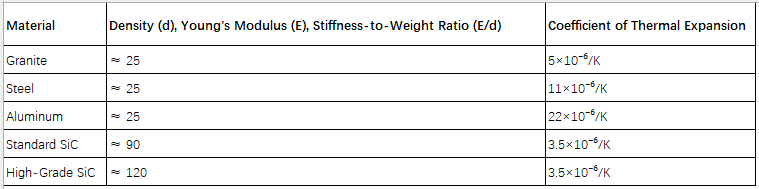
Key Material Parameter Comparison
SiC delivers a stiffness-to-weight ratio 3.6~4.8 times that of traditional materials including steel, aluminum and granite. This means SiC structures achieve roughly twice the natural frequency at the same weight.
Take DynamYX Datum as an example: its first-order natural frequency reaches 300Hz, while granite-based competing products only range from 150Hz to 180Hz.
A higher natural frequency allows higher servo gain, enabling faster step-and-settle time while maintaining system stability.
In terms of thermal stability, SiC has a coefficient of thermal expansion of only 3.5×10⁻⁶/K, one-third that of steel and one-sixth that of aluminum.
In semiconductor manufacturing environments, a mere 0.1°C temperature fluctuation can cause 0.11μm/m deformation on steel stages — translating to tens of nanometers of positioning error over the full travel of a 300mm wafer.
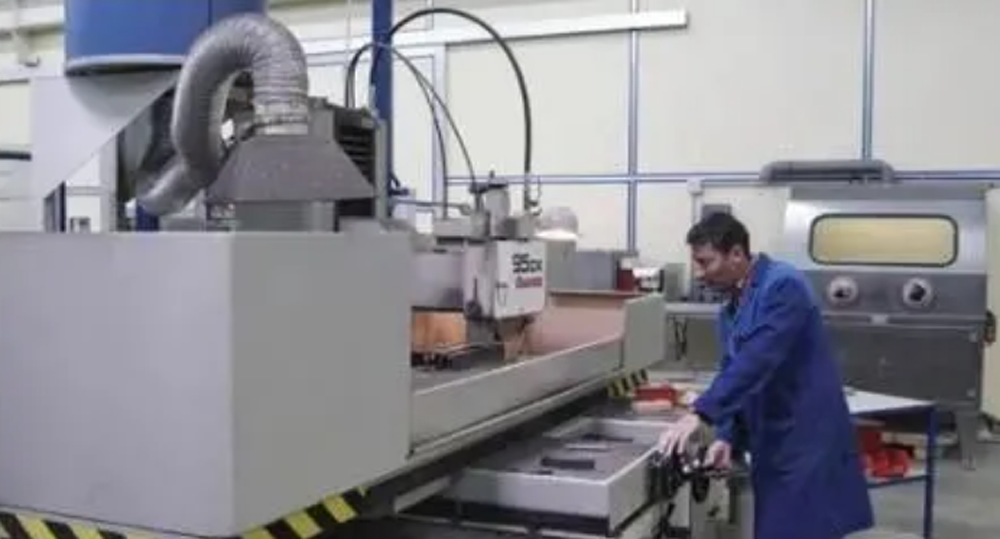
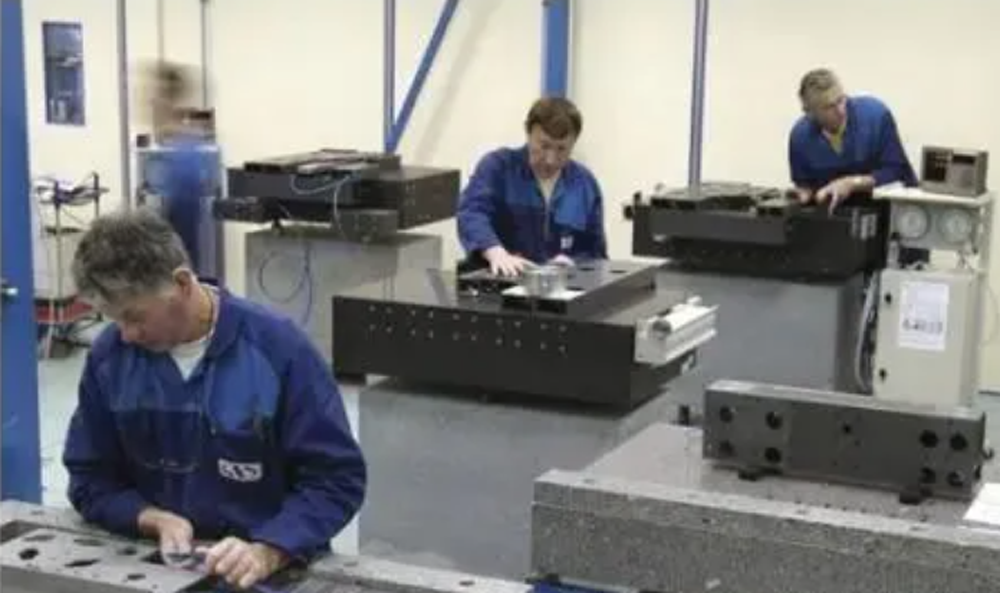
SiC Air Bearing Component Assembly
3.Core Design Philosophy: Monolithic Integrated Structure
The second core technical feature of Newport air bearing stages lies in its Designed-in Precision monolithic design philosophy.
Traditional multi-axis motion stages mostly adopt a stacked architecture: each axis is designed independently and assembled layer by layer.
Stacked structures suffer from inherent flaws: accumulated Abbe error, reduced rigidity from increased overall height, and alignment errors introduced during layered assembly.
Newport’s breakthrough solution integrates XY-axis moving components onto a single-plane SiC ceramic carriage.
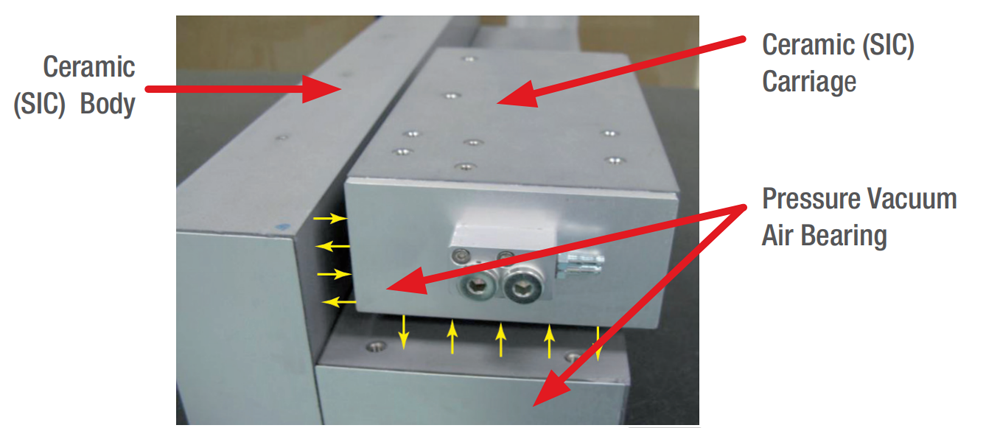
Pressure-Vacuum Air Bearings are directly machined into the ceramic structure, eliminating the need for extra bearing mounts or adjustment mechanisms.
Key advantages of this design:
Minimized Abbe Offset
On DynamYX GT, the vertical distance from the wafer plane to the granite reference surface is only 115mm (including the ZT3 module), among the lowest in the industry. A smaller Abbe offset minimizes the impact of pitch and yaw errors on positioning accuracy.
Minimized Part Count
The core architecture of DynamYX consists of merely 3 monolithic components, reducing error accumulation during assembly and simplifying inventory management as well as after-sales maintenance.
Self-Aligning Air Bearing
Pressure-vacuum preloaded air bearings are directly machined into SiC without external preload structures. The pressure area provides load-bearing capacity, while the vacuum area delivers preload force — together forming an air film with bidirectional rigidity.
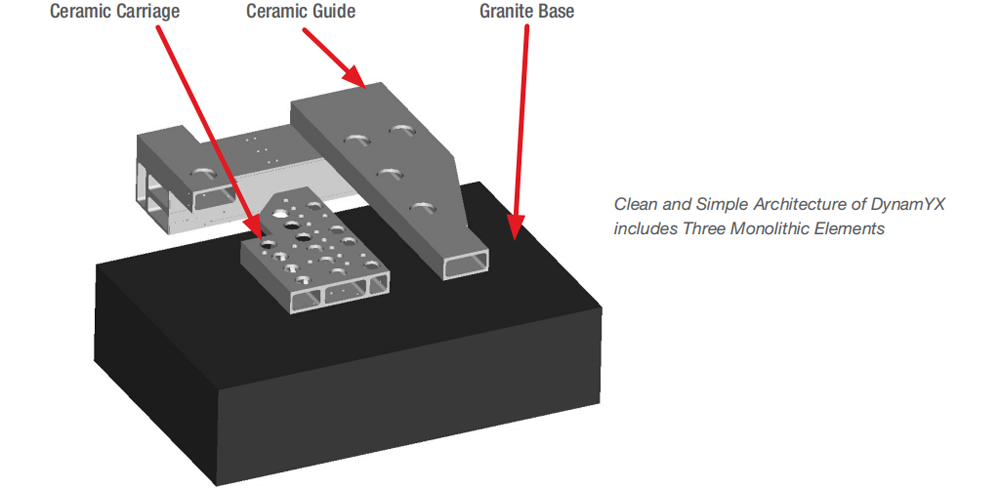
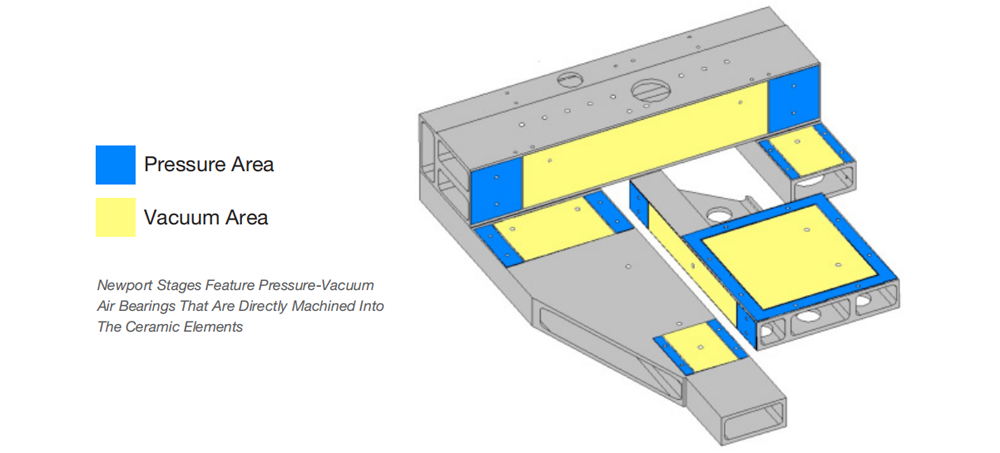
Pressure-Vacuum Air Bearing Working Principle: The pressure area generates buoyancy while the vacuum area provides preload force, both directly machined into the SiC ceramic structure.
4.DynamYX Series: Flagship Stages for Semiconductor Wafer Processing
As the highest-performance product line in Newport’s air bearing portfolio, DynamYX is engineered for 300mm (and future 450mm) wafer inspection, lithography, defect repair and other high-end applications.
Its product family includes four sub-models: DynamYX Datum (Premium Grade), DynamYX GT (High Throughput), DynamYX 300 (Standard Grade), and DynamYX RS (Reticle Stage).
4.1 Drive Architecture: Dual-Motor vs Single-Motor
DynamYX 300 and RS adopt a standard dual-motor layout, with one coreless linear motor for each X and Y axis.
GT and Datum models add a second auxiliary linear motor on the X axis running in open-loop mode.
This is not a synchronized dual-motor H-Bridge structure; the secondary X motor shares the same control signal as the primary motor, with output force distributed via force biasing. The overall control logic remains equivalent to a standard 2-axis XY system.
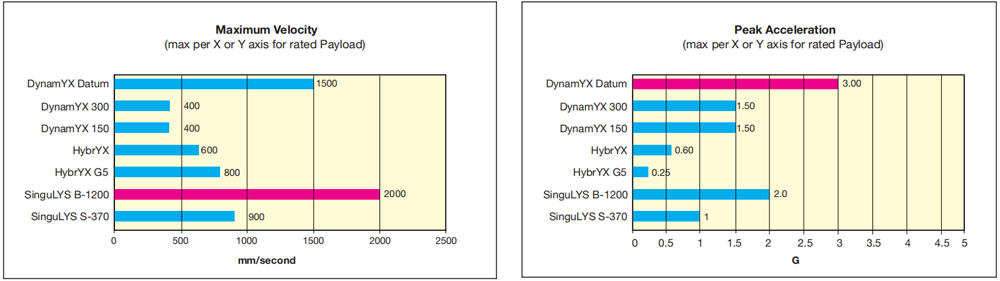
The ingenuity of this design lies in boosting X-axis thrust reserve without increasing control complexity. It enables a peak acceleration of 3G on the X axis and 5G on the Y axis for Datum models — drastically shortening die-to-die travel time for high-throughput inline inspection equipment.
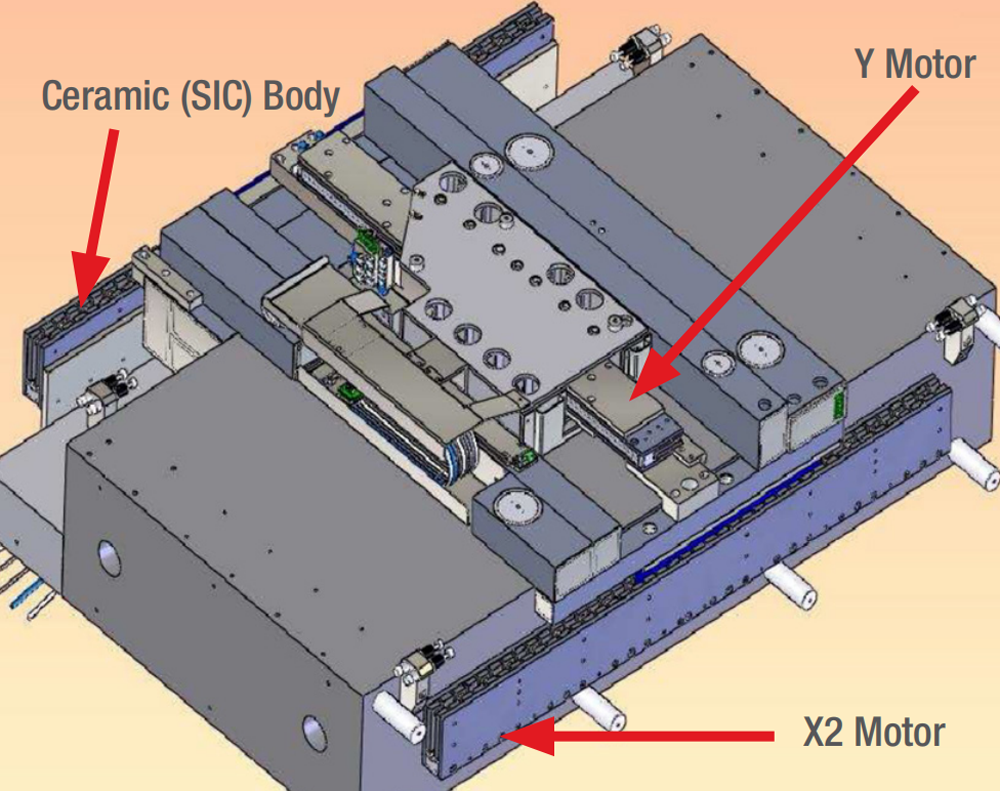
DynamYX GT and Datum adopt three linear motors: two for the X axis and one for the Y axis.
4.2 Motor Technology: In-House High-Efficiency Linear Motors
Newport strategically designs and manufactures linear motors in-house instead of sourcing commercial off-the-shelf units.
It evaluates motor performance with a custom indicator — Steepness = F²/W / Motor Volume, which represents thrust output per unit heat generation within a fixed motor size.
This metric is critical for thermal management: higher motor efficiency means less heat dissipation required, minimizing thermal expansion-induced positioning deviation.
For extreme operating conditions with high RMS acceleration, optional forced air cooling or recirculating water cooling is available, with cooling pipelines integrated into the motor structure.
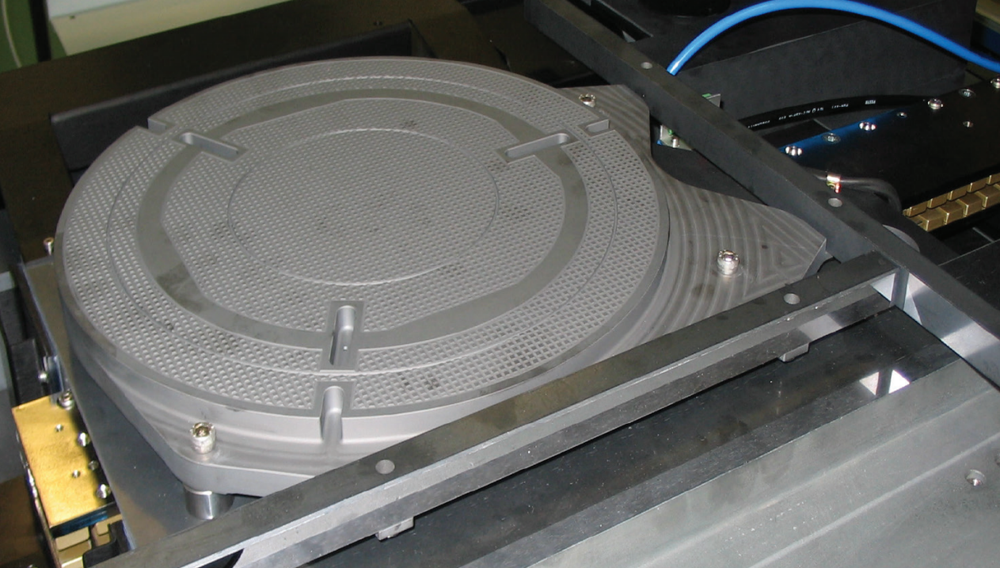
Ceramic Chuck integrated with SiC interferometer mirror — matched coefficient of thermal expansion for direct mounting.
4.3 Position Feedback and Accuracy Grades
DynamYX offers two tiers of position feedback solutions:
Standard Solution: Linear Grating Encoder
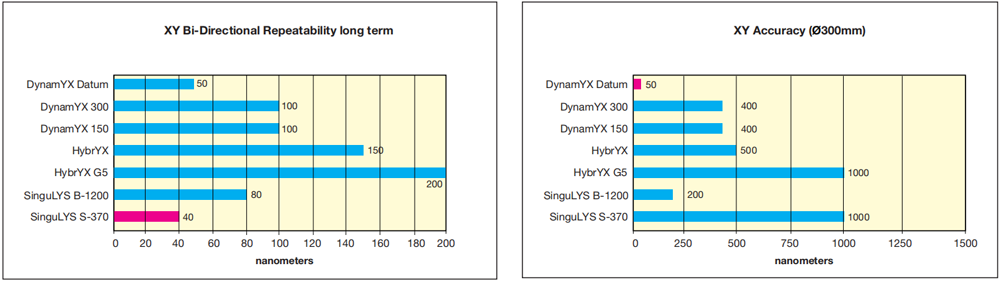
Equipped with Heidenhain LIF glass linear scale featuring a 4μm signal period. With 20,000× interpolation inside the XPS controller, the resolution reaches 0.1nm. After error mapping compensation, XY positioning accuracy hits 0.2~0.4μm within a 300mm travel range (model-dependent).
Premium Solution: Laser Interferometer
For ultra-precision applications beyond encoder capability (such as lithography and nanoimprint), an Agilent laser interferometer system can be deployed.
Paired with Newport’s patented SiC Replica Mirror technology — fabricated via optical replication instead of traditional grinding — it delivers lower cost and superior surface quality. The Datum model achieves 50nm XY accuracy over 300mm travel with interferometer configuration.
An interesting design tradeoff can be seen in parameter specs: the rated load of Datum (3kg) is lower than GT (6kg) and 300 (5kg).
This is because Datum prioritizes extreme dynamic performance with 5G acceleration, requiring minimized moving mass — a classic engineering compromise of trading load capacity for speed.
4.4 Open-Frame Compatibility
For reticle inspection and repair applications requiring transmitted optical paths (simultaneous top and bottom observation), DynamYX supports an Open-Frame configuration.
A cantilever SiC ceramic frame is mounted on the XY air bearing carriage, lifting substrates and reticles far away from moving components.
Compared with traditional H-Bridge open-frame structures, this design features a much smaller footprint, and the full open aperture enables flexible integration and easy maintenance of optical assemblies.
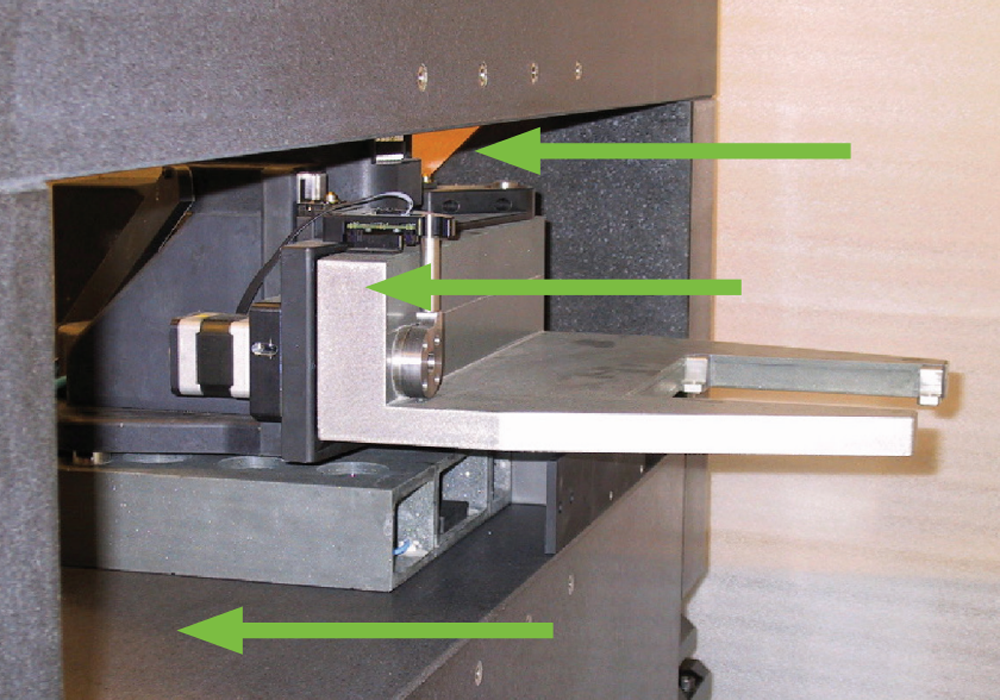
Open-Frame Configuration: Reticle and optical components isolated from moving parts; airflow prevents particle ingress into clean areas.
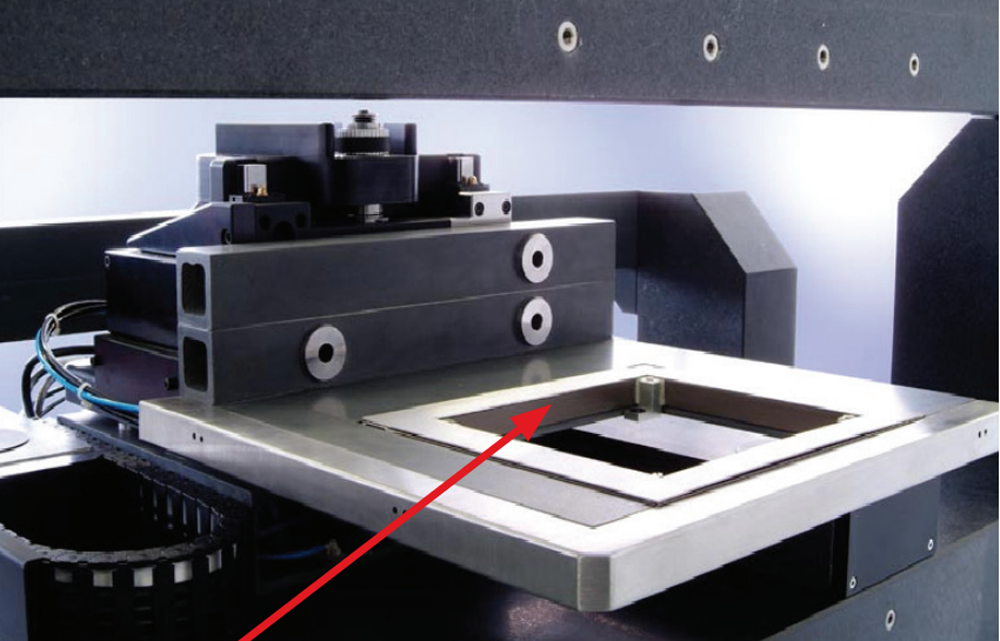
Full-Open-Aperture design enables unobstructed optical integration channels.
5. HybrYX Series: Hybrid Air Bearing + Mechanical Bearing Solution
The high cost of full air bearing stages often deters OEM customers.
The HybrYX series is positioned to deliver core single-plane air bearing advantages at a lower cost via an ingenious hybrid architecture:
Y Axis (Scan Axis): The SiC ceramic carriage is suspended above the granite reference surface by pressure-vacuum air bearings, guided along the Y direction by a lightweight SiC beam. Air bearings dominate here,delivering ultra-low speed ripple and excellent scanning performance.
X Axis (Stepper Axis): Both ends of the ceramic beam are supported and guided by recirculating ball bearing carriages. Mechanical bearings take charge here, covering long travel at low cost.
This Y-axis air bearing + X-axis ball bearing hybrid design retains premium scanning performance on the critical Y axis while cutting overall cost to a fraction of a full air bearing solution.
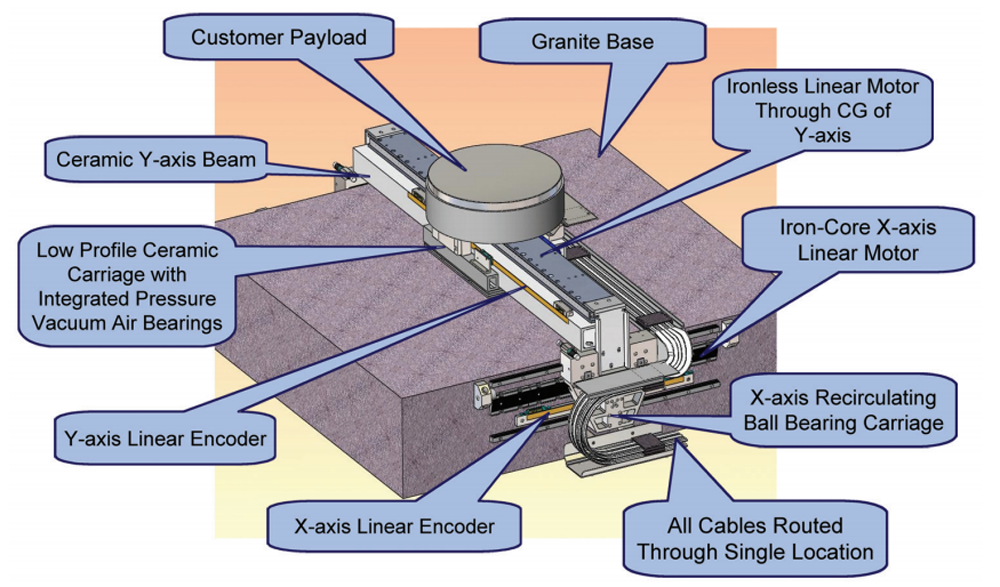
HybrYX Hybrid Architecture: Y axis with air bearing guidance; X axis supported by double-row ball bearings.
5.1 Dynamic Performance: Ideal for Scanning Applications
HybrYX delivers impressive performance in scanning mode:
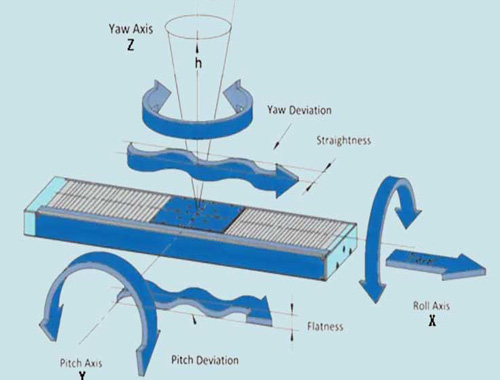
Z-axis jitter and dynamic straightness: below ±25nm at high speed
Speed ripple: better than 0.1% (sampled at 2kHz under 400mm/s)
Maximum Y-axis scanning speed: 600mm/s; acceleration: 0.6G
MTBF:20,000 hours
The HybrYX-G5 is the long-travel variant designed for Gen-5 Flat Panel Display (FPD) substrates and photovoltaic panels.
Its Y-axis travel extends to 1400mm, supporting a 30kg payload (with ZT3 module). For large-size panel inspection, this travel perfectly covers single-axis scanning requirements for Gen-5 (1100×1300mm) substrates.
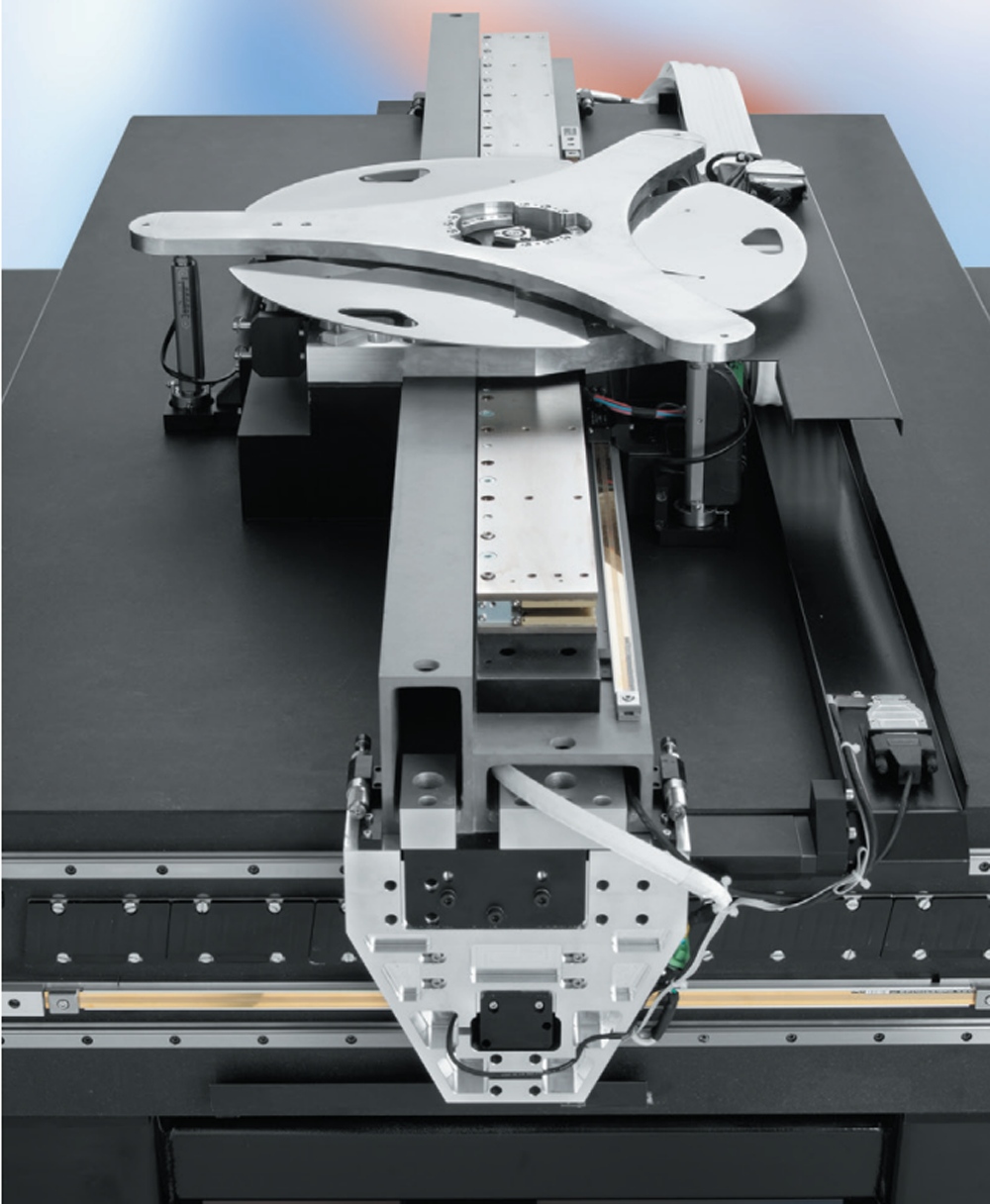
HybrYX-G5 can be optionally equipped with a Z-Tip-Tilt-Theta module to provide 6-axis positioning without significant increases in height and mass.
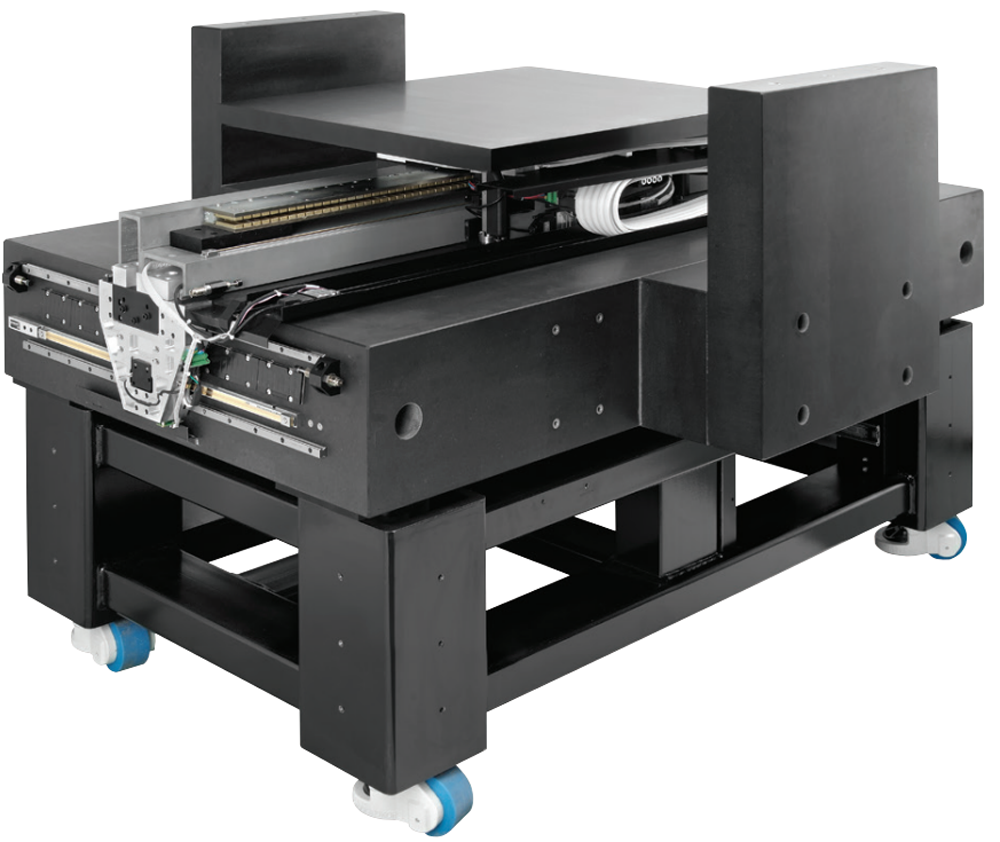
HybrYX-G5 Positioning Stage — Single-plane architecture tailored for large-size substrates.
6. SinguLYS Series: Modular Single-Axis Air Bearing Solution
Not all applications require dual-axis XY air bearing stages.
For scenarios adopting split-axis XY layout or gantry architecture, Newport launched the SinguLYS modular single-axis air bearing stage. The series includes two core building blocks:
SinguLYS S-370 (L-Type Single-Axis Stage): Integrated monolithic SiC L-base with air bearing carriage, 370mm travel. Its self-supporting 3-point mounting design eliminates the need for large precision-ground installation surfaces, making it ideal for replacing traditional mechanical bearing stages in compact spaces.
SinguLYS B-1200 (Air Bearing Bridge): Standalone SiC ceramic bridge beam with air bearing carriage, 1200mm travel, 10kg rated load. The SiC beam weighs only one-third of steel while offering 3 times the rigidity of granite. When replacing steel or granite gantry bridges on existing equipment, the B-1200 boosts acceleration up to 2G and shortens settling time with minimal system modification.
SinguLYS S-370: Compact single-axis air bearing stage, 370mm travel with 3-point mounting.
SinguLYS B-1200: Ceramic air bearing bridge for Gen 8–11 flat panel inspection and thin-film photovoltaic scribing applications.
7. System Integration and Accessory Ecosystem
7.1 XPS Motion Controller
Newport recommends the XPS universal motion controller as the standard control solution for air bearing stages.
A 19-inch 4U standalone controller, the XPS can drive and synchronously control up to 8 axes of brushless linear/rotary motors, brushed DC motors and stepper motors.
Key specifications:
Servo loop frequency: 10kHz
Supports tunable PID, low-pass & notch filters, feedforward compensation and 3D error mapping
Enables linear and orthogonal error compensation
High-speed I/O: Low-latency Position Compare and Input Latching
Communication:10/100 Base-T Ethernet
7.2 Reaction Force Compensation System
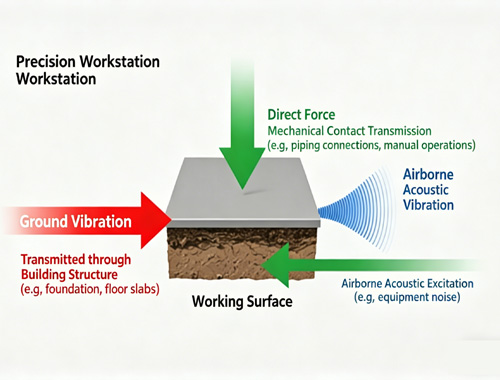
Reaction force generated by high-speed stepping motion of air bearing stages can excite resonance on vibration isolation platforms, prolonging settling time.
Newport’s Reaction Force Compensation System diverts reaction force from moving components to an inertial mass in the opposite motion direction, effectively suppressing resonance.
Core strengths:
Cost-effective:Delivers performance close to active vibration isolation at far lower cost
Easy integration: Requires no additional position feedback or sensors
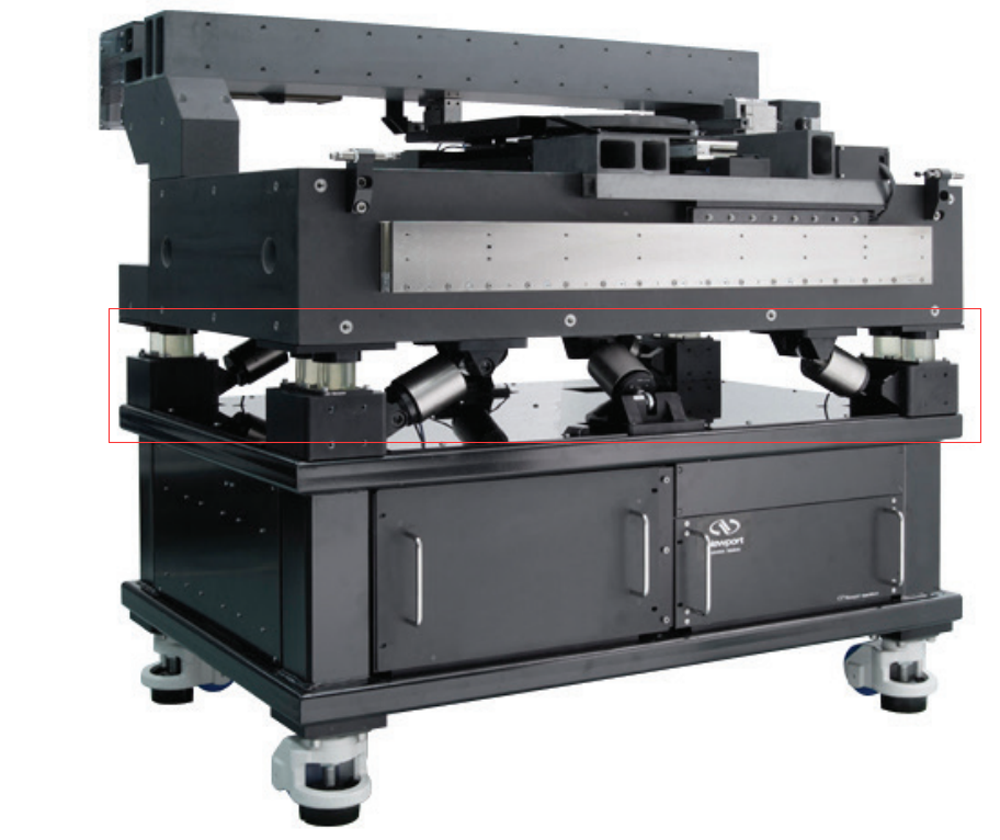
DynamYX Datum equipped with XY Reaction Force Compensation System.
7.3 Ceramic Wafer Chuck and Interferometer Mirror
When accuracy demands reach tens of nanometers, material matching between chucks and mirrors becomes critical. Newport provides a full SiC ecosystem:
Ceramic Wafer Chuck: Compatible with 200mm and 300mm wafers, with backside contact area below 2% and flatness up to 100nm per 50mm² area. Matched thermal expansion coefficient with the stage enables direct mounting, eliminating complexity and instability introduced by mechanical assembly.
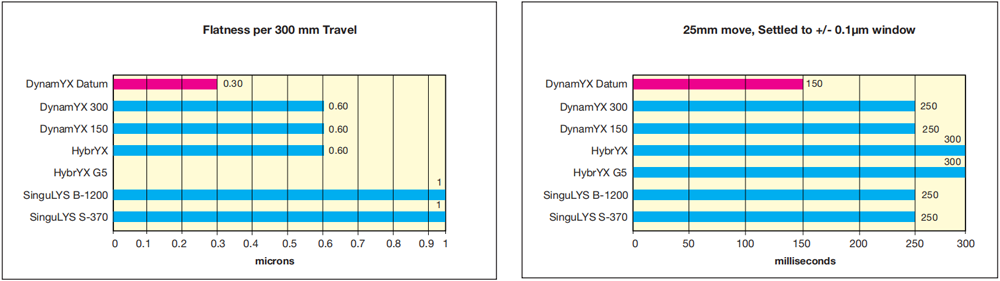
SiC Replica Mirror: Fabricated via Newport’s patented optical replication process (instead of conventional grinding), directly bonded to the ceramic chuck. Mirror flatness reaches 0.3μm/300mm and 0.1μm/50mm. Its thermal conductivity far exceeds Zerodur (traditional interferometer mirror material), minimizing thermally induced surface distortion.
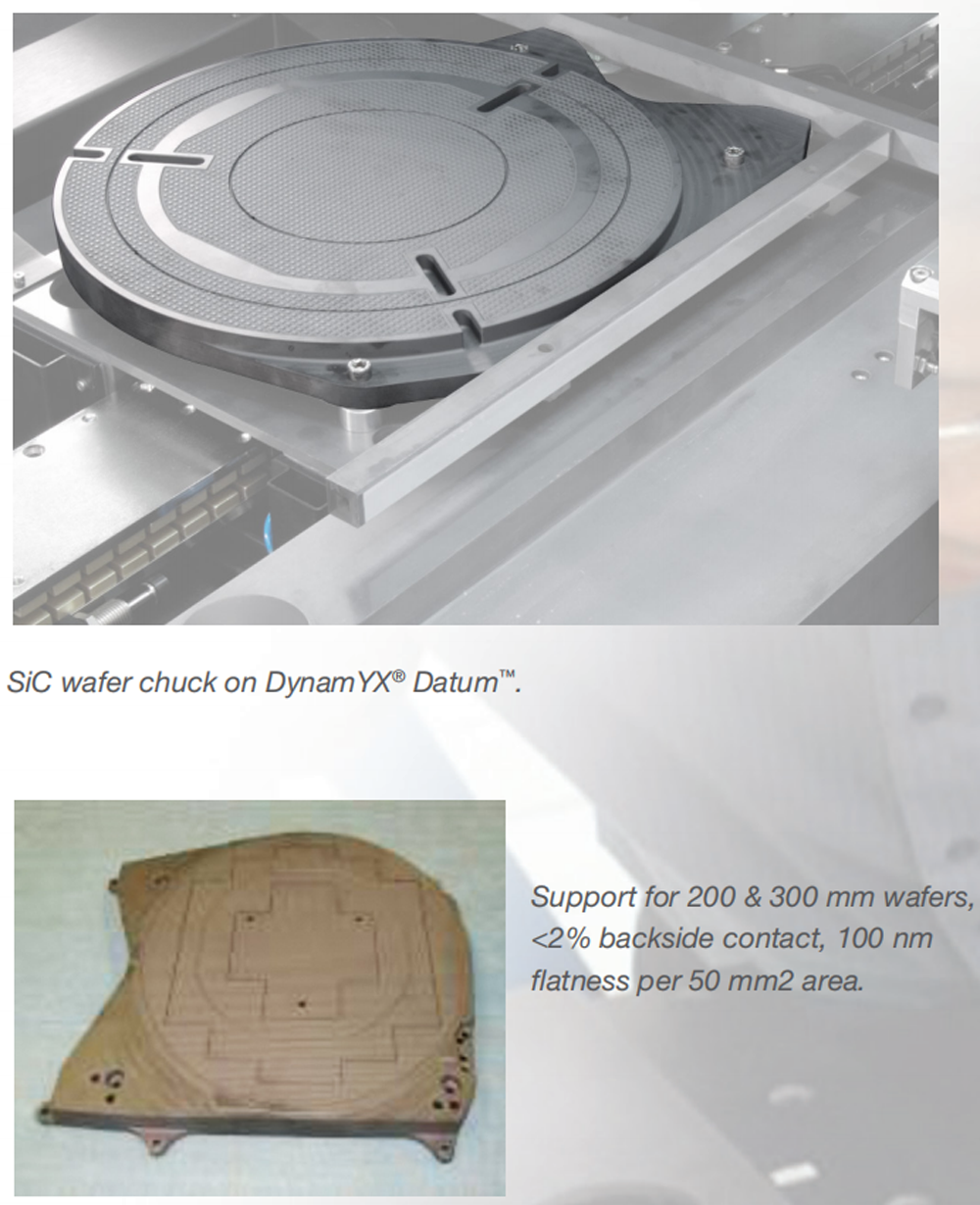
SiC Ceramic Wafer Chuck: Lightweight, high flatness and thermally matched.
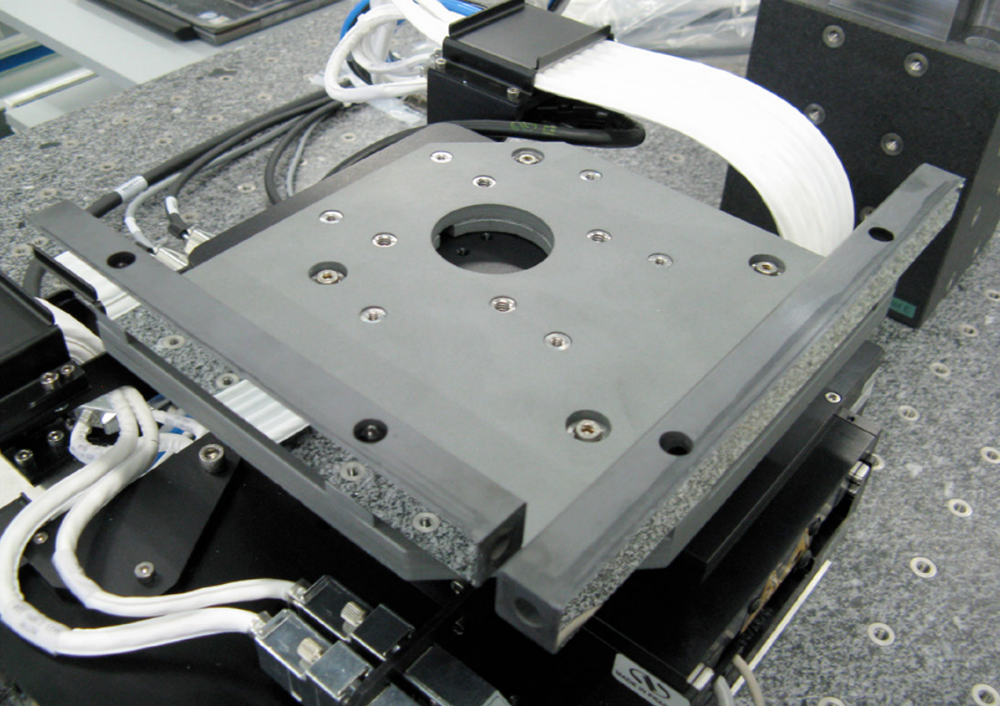
Ceramic plate integrated with SiC replica interferometer mirror, delivering 50nm bidirectional XY repeat positioning accuracy.
8. Large-Scale Ceramic Bridge Structure
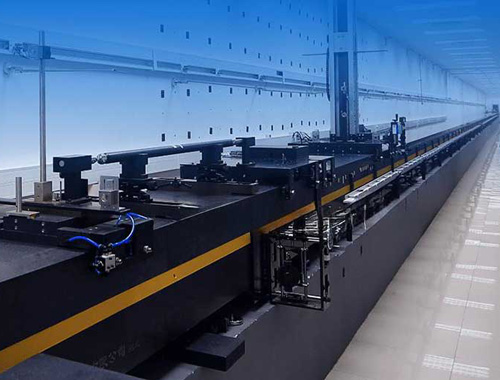
Most Newport air bearing systems are delivered as turnkey solutions equipped with an overhead bridge for optical system integration.
The bridge acts as a critical link in the precision chain; positioning accuracy and stability are generally referenced between the wafer and designated points on the bridge.
With profound expertise in material science and structural analysis, Newport customizes optimal bridge designs for application-specific requirements.
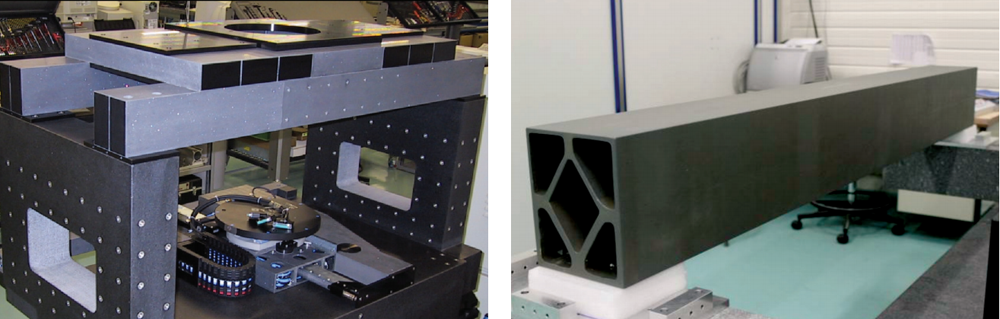
| Large-Scale SiC Ceramic Bridge Structure — Lightweight, high rigidity and thermal stability. | Full System Integration: Air Bearing Stage + Bridge + Optical System |
Key Takeaway
Selecting an air bearing stage is never a simple parameter comparison; it is about finding the Pareto optimal balance across four dimensions: accuracy, speed, load capacity and cost.
Through vertical integration of SiC ceramic materials, monolithic single-plane architecture, and pressure-vacuum preloaded air bearings, Newport has built an impenetrable technological barrier in precision motion control for large scientific installations and semiconductor manufacturing.