Engineers frequently face a variety of challenges when working with motion control systems. Today, ND Group addresses and answers the common issues found in precision motion systems built on granite bases.
Q1: How do we define "precision" when talking about motion control and nanopositioning?
In classic mechanical engineering, "precision" has a textbook definition: the dispersion of repeated positioning test results relative to the mean, measured by an ideal gauge.
But when you shrink things down to the sub-micron and nanoscale, this textbook definition falls short. While precision is undoubtedly limited by classic hardware specifications, there is a much bigger picture to consider. Ultimately, the user's specific application dictates which factors matter most. That is why it is crucial to partner with a supplier who can evaluate the application holistically.
Depending on what you are trying to achieve, precision might also mean the ability to maintain a steady velocity or navigate a multi-dimensional path with near-zero deviation. Beyond just repeatability (the ability to reliably return to the exact same spot), you have to factor in minimum incremental motion (often mistakenly confused with sensor resolution) and overall accuracy (how close the actual position is to the theoretical target). In some scenarios, blindly following pre-set coordinates might not be the top priority; instead, dynamically tracking a target based on specific external feedback could be the ultimate goal.
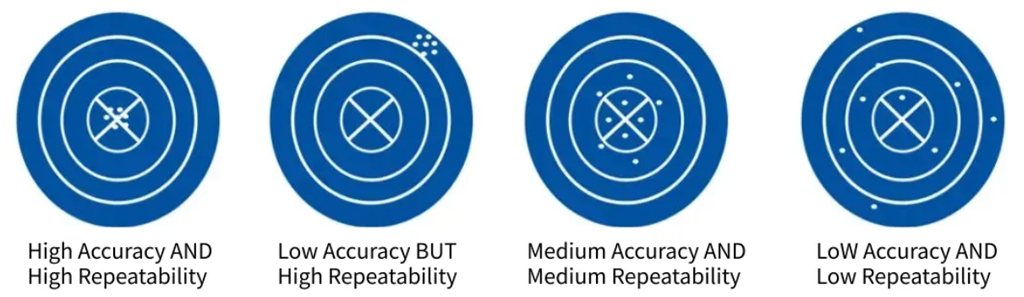
Graphical representation of accuracy and repeatability
Let's look at a real-world example: coupling a fiber optic cable to a laser diode. The application might demand a coupling repeatability of 0.02 dB, which must be verified through statistically valid measurements. While classic mechanical positioning repeatability is important here, it simply isn't enough to guarantee this level of success. The real game-changer is the performance of the motion controller’s alignment algorithms. How fast these algorithms can get the job done is also a critical metric. Tackling challenges like this requires a supplier with deep, specialized expertise—someone who doesn't just sell motors, but truly understands the broader application context.
Therefore, when we define "precision within the framework of motion control," we treat it as an integral part of a deep dive into the application and its ultimate goals.
Q2: How does motion control performance impact process variation?
Process variability is directly tied to positioning accuracy. To understand this, you have to look at the system as an orchestra where many instruments play together: mechanical components (like bearings, drive screws, material combinations, and base plate flatness), the type and presence (or absence) of feedback devices, the quality and noise levels of the electronics, and the sheer processing power of the motion controller generating and correcting the motion paths. Finally, the accuracy of the sensor data and the external information the system relies on to adapt its movements will dictate the overall precision and process variability.

A configurable, flexible multi-axis motion system featuring an EtherCAT-based ACS motion controller
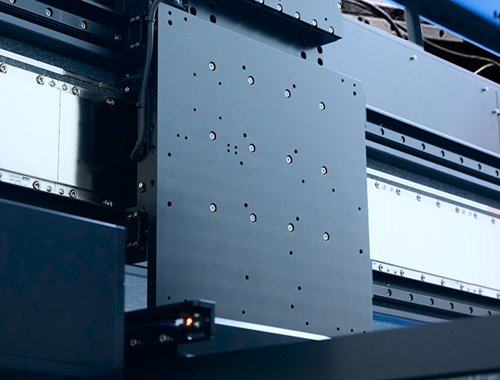
A granite-based motion system (shown above), commonly used in laser processing applications
Q3: Which industries rely on precision positioning and motion control the most?
Precision motion control is the unsung hero in any process where even a microscopic deviation can lead to total failure or disastrously low yields. Here are a few key arenas:
Laser Processing & Machining: The accuracy of positioning stages, fast steering mirrors, or galvo scanners directly dictates the quality of the final product. A sloppy positioner—one with poor repeatability or laggy path and speed control—leads to dimensional deviations and scrapped parts. A classic symptom is laser-drilled holes that come out oval with unwanted burrs instead of perfectly crisp circles, or sidewalls with unintended tapers because the controller and mechanics simply couldn't compensate fast enough. When production scales up, these microscopic errors are aggressively magnified.
Microscopy: Imagine scanning a biological sample and needing to return to one specific, microscopic point for further analysis. Your success depends entirely on the positioner's repeatability. Modern microscope stages can now nail this with nanometer-level repeatability.
Photonics: The demand for Photonic Integrated Circuits (PICs) is projected to skyrocket by three orders of magnitude in the near future. Finding the perfect alignment "sweet spot" requires a positioner that can scan optical couplings and reliably snap back to the exact coordinate where the highest photon flux was observed or calculated. To hit performance targets, automated alignment, testing, and assembly equipment must operate with accuracies measured in tens of nanometers.
Semiconductor Manufacturing: In lithography, wafer probing, and assembly, high-precision motion control is a matter of survival. An error of just a few single-digit nanometers can ruin a batch of chips.
Aerospace: High precision is mandatory for beam-steering systems used in free-space optical communication between satellites, as well as for aligning cameras and space-grade optical components.
Optics: Manufacturing high-end optical components requires active optical alignment of multi-lens systems. From the tiny camera in your smartphone to the dizzyingly complex lenses and mirrors inside modern lithography machines, achieving focus and clarity usually demands nanometer to sub-nanometer precision.
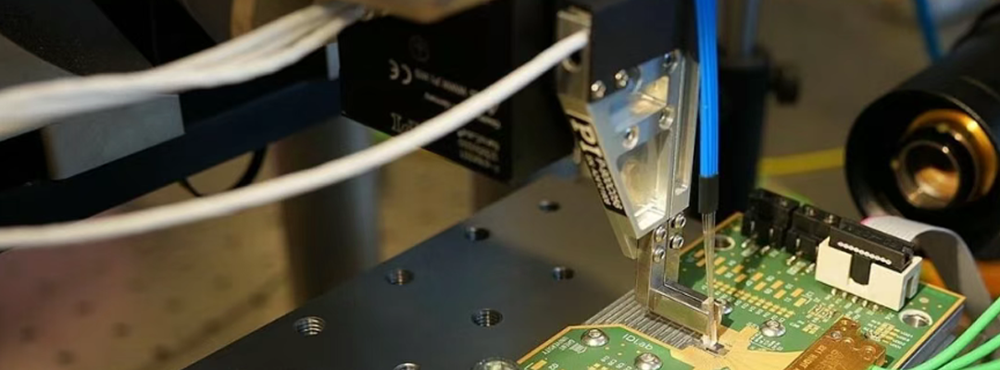
A motion system for data center applications, aligning an IMEC 6-channel fiber array to a silicon integrated electro-optic receiver.
Q4: In what real-world applications have advances in precision motion control made a striking impact?
Semiconductor Technology: Modern society runs on silicon—specifically, integrated circuits like CPUs, microcontrollers, and memory modules. The relentless shrinking of physical dimensions, famously known as Moore's Law, has driven unprecedented boosts in processing power while slashing costs by squeezing more chips onto a single wafer. None of this would be possible without the relentless evolution of motion control repeatability, pushing down into the sub-micron and nanometer realms. In the 1960s, the feature size of early microprocessors was around 10 microns. Today's cutting-edge chips boast single-digit nanometer architectures. Without breakthroughs in motion control, precision mechanics, and optics, AI and self-driving cars would still be confined to science fiction.
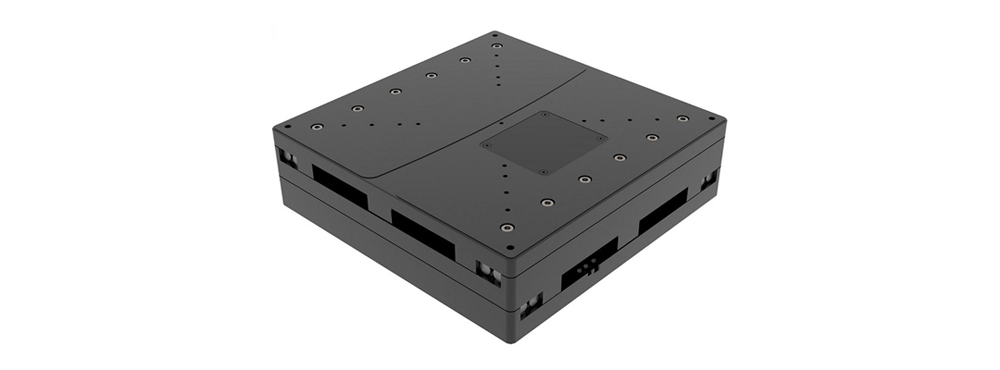
A flexure-guided XY piezo nanopositioning stage for semiconductor applications
Metrology: Measuring precision requires precision itself. The motion control systems powering Coordinate Measuring Machines (CMMs) and other inspection tools typically need to boast resolutions and accuracies 10 times higher than the devices they are measuring. This extreme metrology ensures manufacturing tolerances are met and slashes defect rates. For high-end optics, the key lies in flawlessly measuring curvature and surface smoothness, as even the slightest imperfection will distort light and ruin optical performance.
Super-Resolution Scanning Microscopy: Advances in nanopositioning scanning and motion control have unlocked optical resolutions capable of imaging the nanoscopic structures of living biological processes. This represents a monumental leap in resolution, surpassing classic diffraction-limited static microscopes by several orders of magnitude.
DNA Sequencing: The widespread adoption of rapid genomic analysis simply wouldn't exist without modern motion stages and controllers. A typical setup requires highly synchronized three-axis coordination: the XY plane aggressively scans the sample, while the Z-axis relies on a high-speed focusing stage to maintain peak optical resolution and maximize throughput.
Ophthalmic Surgery: Motion systems and controllers that perfectly synchronize laser pulses with spatial motion paths are the foundational prerequisite for successful corrective laser eye surgeries.
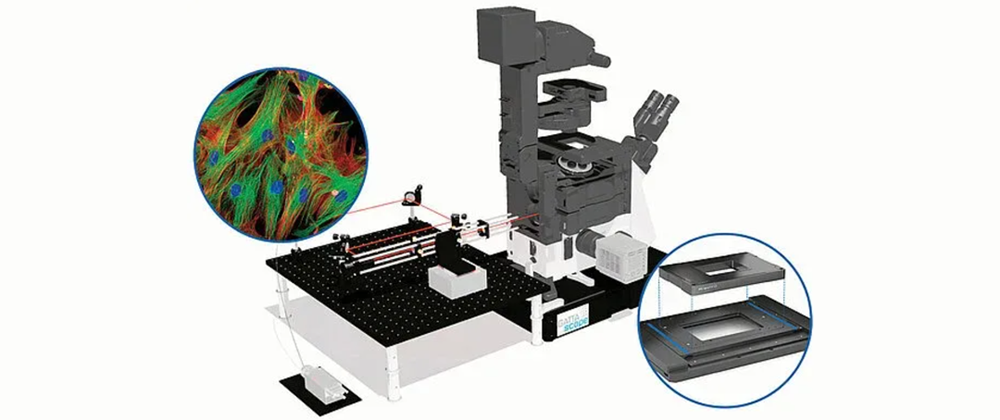
Example of a TIRF microscope: GATTAquant's GATTAscope utilizes piezo technology to achieve nanometer-level position resolution. (Image courtesy of GATTAquant)
Q5: What are the typical hurdles in achieving high-precision motion control?
The greatest challenge is realizing that precision isn't enough to guarantee success. It requires orchestrating a multitude of variables, especially managing the operating environment and the vibrations induced by the motion itself. Ideally, a motion control supplier shouldn't just be a vendor, but a consulting partner who leverages deep experience from similar applications.
As a rule of thumb: as precision requirements go up, the engineering challenges multiply exponentially.
Mechanical Issues: Friction, backlash, vibration, and bearing noise are notorious culprits. The most elegant ways to conquer these include using frictionless air or magnetic bearings, flexure hinges, and frictionless direct-drive mechanisms (like linear or torque motors) or piezo actuators.
Vibration: This is a formidable enemy. Vibrations can seep in from the external environment or be generated internally by motors, bearings, or jerky acceleration/deceleration profiles. To fight performance-killing vibrations, engineers deploy ultra-rigid designs, intelligent control algorithms (such as input shaping, servo-boost, or NanoPWM drives), or built-in active vibration cancellation units. For floor-borne vibrations, passive air isolators or >>active piezo isolation floors (like TMC Stacis) are the go-to solutions.
Sensor Bandwidth, Resolution, and Accuracy: Encoder resolution and linearity are massive sources of system error. Upgrading to high-precision encoders and utilizing linearization tables based on high-end laser interferometer calibrations (embedded directly in the controller's firmware) can drastically compensate for these errors and elevate system accuracy.
Control System Bandwidth: A sluggish bandwidth leads to delayed system responses, massive following errors, and frustratingly long settling times. Choosing a system with blazing-fast servo update rates and an EtherCAT communication architecture is a fundamental stepping stone to success.
Misleading Specifications: Another hurdle is that data sheet specs often don't reflect real-world application realities. Take "repeatability" as an example. It is often visualized using a "honeycomb" scatter plot: the stage makes N moves in one direction, followed by N reverse moves. The repeatability is judged by the positional deviation between the forward and reverse steps. However, this test is fundamentally flawed because it only includes one actual reversal of direction, meaning you aren't truly getting N valid data points of bidirectional performance. The ISO 230-1 standard provides a much more rigorous and punishing measurement protocol.
A statistically superior method involves starting from M random offset positions. After each offset, the stage executes a random move and attempts to return to home. By repeating this M times and recording the deviation between the random start and the return point, you generate a repeatability plot that follows a true Gaussian distribution. Crucially, in this test, every single data point involves a directional reversal! This perfectly mimics how most machines actually operate in the real world. While time-consuming, this test ruthlessly exposes a motion system's hidden flaws.
Furthermore, most precision applications require multi-directional movement. You cannot simply deduce the holistic accuracy of a system by looking at the spec sheet of a single axis. In these cases, employing multi-axis error mapping—though complex to implement—can dramatically boost positioning accuracy in real-world 3D space.
Finally, keep in mind that precision specs are often presented as static numbers, but motion is inherently dynamic. A system might behave flawlessly at a contouring speed of 30 mm/s, but fall apart completely at 500 mm/s.
Q6: What environmental conditions affect the accuracy of a motion control system?
As mentioned, vibrations must be squashed down to levels that match your application's goals. If you need a scanning resolution of 0.5 microns (typical in life sciences, photonics, and semiconductors), the vibration amplitude of your support structure and components must physically be smaller than that.
Thermal Fluctuations: Temperature shifts cause materials to expand and contract, throwing off tolerances and alignments. This is especially disastrous in systems built from mixed materials—like bolting steel bearings onto an aluminum stage body. The mismatched expansion rates will literally bend the guide rails, destroying positioning accuracy.
Extreme Temperatures: In cryogenic aerospace applications, the extreme cold drastically increases friction in bearings and lead screws. Conversely, intense heat thins out lubricants, destroying their protective properties.
Vacuum Environments: Operating in a vacuum requires exotic materials, specialized lubricants, and the venting of all blind tapped holes to prevent "virtual leaks" from trapped gas.
Contamination: Dust, humidity, and metallic particles are fatal to precision. They introduce chaotic friction, foul up bearings and optical encoders, and trigger electrical interference or mechanical wear. In ultra-high resolution setups or cleanrooms, these contaminants destroy repeatability and force constant maintenance. To survive, motion systems must be armored with clever protective designs to keep the outside world out.
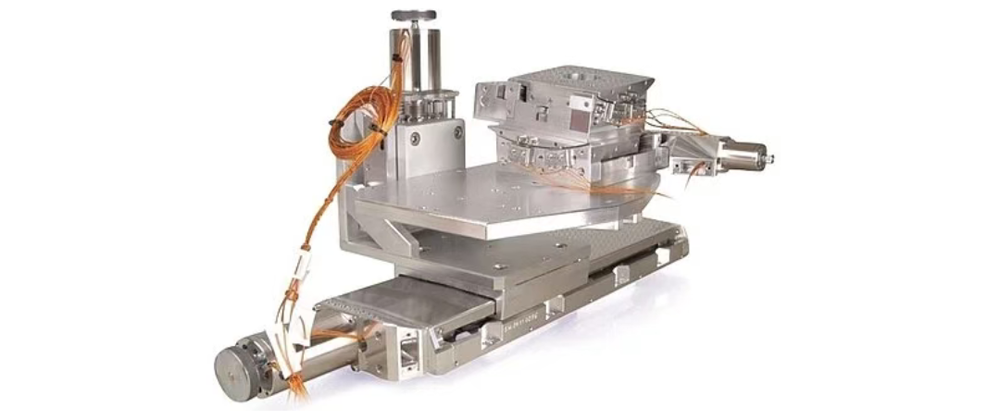
Motion systems operating in high-vacuum (HV) and ultra-high-vacuum (UHV) environments require specialized materials and more rigorous testing to ensure reliable performance
Q7: How does system complexity impact motion control performance?
Sometimes, complexity is as mundane as managing thick bundles of cables—yet every single wire acts as a mechanical spring, transmitting unwanted forces and vibrations directly into the heart of your sensitive application.
Complexity also arises from stacking too many moving parts. Every time you bolt one mechanical component onto another, you lose structural stiffness. This lost stiffness breeds vibration and introduces stacking errors. Using excessively long structural components also creates leverage (torque) that further saps stiffness, lowers the resonant frequency of the machine, and horribly prolongs settling times.
This is why elegant, mathematically simple, and compact kinematic designs always win in precision. Compare a sleek, 6-axis hexapod utilizing parallel kinematics against a towering, wobbly stack of six individual single-axis stages.
Multi-axis systems are notoriously difficult to tame because the guiding errors from each degree of freedom stack up and contaminate the other axes. For example, if your X-axis linear stage suffers a microscopic 1-micron sideways wobble (runout), your actual position will deviate by 1 micron relative to your target, even if your Y-axis is perfectly accurate on its own. Fixing these crosstalk errors requires intense multi-axis error mapping using complex laser interferometer arrays.
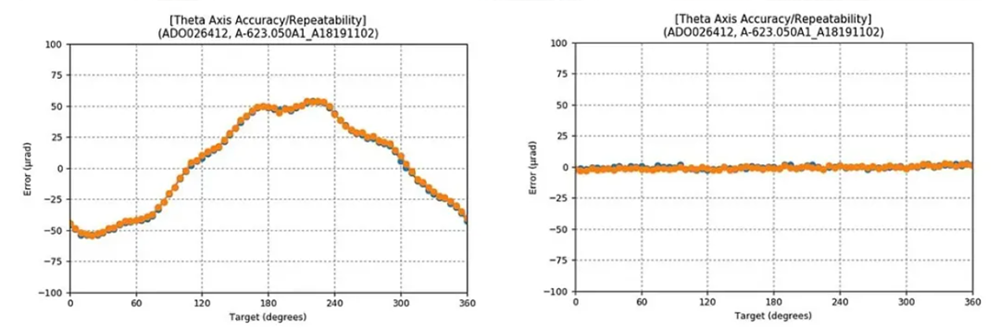
Comparison of positioning error and repeatability for an air-bearing rotary stage, before and after error mapping
Q8: What strategies can be used in motion system design to overcome precision challenges?
To defeat the root causes of error, engineers deploy an arsenal of advanced strategies.
Material Science: To maintain accuracy across varying temperatures, engineers use materials with a extremely low Coefficient of Thermal Expansion (CTE), such as granite, Invar, ceramics, or Zerodur (a lithium aluminosilicate glass-ceramic). But matching these materials is just as vital. Bolting a dimensionally stable Invar stage onto an aluminum base is a recipe for disaster, as the expanding aluminum will forcefully warp the Invar.
Drive & Feedback Architecture: Using direct-measurement linear encoders paired with frictionless, direct-drive motors—and mounting them as close to the center of the payload as possible—drastically cuts down Abbe errors caused by twisting forces (torque). A centrally mounted linear motor also minimizes geometric distortion of the moving carriage.
Kinematic Design: For XY and XY-Rot-Z positioning, a planar design (parallel kinematics) is vastly superior. Because all axes share the exact same base plate, the design inherently possesses massive stiffness, zero friction, and flawless geometric stability. This is the secret sauce behind planar air bearing systems, magnetic levitation stages, and piezo flexure stages.
For 6-degree-of-freedom positioning, a parallel-kinematic hexapod blows traditional stacked stages out of the water. Hexapods offer a incredibly compact footprint, immense structural rigidity, a mathematically programmable pivot point, and zero cumulative guiding errors. Furthermore, because the motors are stationary, hexapods eliminate the dragging friction and torque of moving cable tracks, supercharging both precision and dynamic responsiveness.
Advanced Metrology and Control: External metrology systems, like laser interferometers, provide absolute position feedback totally independent of the drive mechanics, pushing accuracy to the absolute physical limits.
On the electronics side, cutting-edge control algorithms and ultra-low current ripple drives (like the ACS NanoPWM) dramatically boost system stability and resolution. External metrology can be used to build rich error maps inside the controller's memory. If the controller has enough bandwidth and raw processing power, it can execute these corrections on the fly during high-speed motion, rather than just adjusting at the final stopping point.
The Ultimate Strategy: Partner with a veteran motion system supplier. You want a team that freely shares their knowledge and acts as a true collaborator. Beyond the massive engineering advantages of bringing them in early, the ideal partner should possess deep technical reserves and a business model capable of supporting you from the first R&D prototype all the way to massive, rapid commercial scaling.
Q9: What recent innovations in motion control have elevated precision?
AI in Silicon Photonics: Aligning fibers to lasers, microlenses, waveguides, and fiber arrays requires nanometer accuracy. In mass industrial production, speed is just as critical as precision. Today, revolutionary AI-powered alignment algorithms have slashed alignment times by several orders of magnitude.
Picometer Encoders: Optical encoder technology refuses to stand still. The latest models can now resolve position down to the picometer level. Simply put, a motion system can only be as accurate as the sensor telling it where it is.
Hybrid Actuation: Engineers are now blending traditional servo motors with lightning-fast piezo mechanisms. These hybrid systems share a single, sub-nanometer resolution linear scale for feedback. A specialized servo controller splits the signal: blasting high-frequency data to the piezo drive for instantaneous micro-corrections, while sending low-frequency data to the servo drive for heavy, macro movements.
This exact hybrid approach powers the >2,000 nanopositioning actuators on the Extremely Large Telescope (ELT), the largest optical telescope on Earth. By utilizing three actuators per mirror segment, the system achieves single-digit nanometer path accuracy while tracking the stars.
AI and Machine Learning Control: In traditional feedback/feedforward loops, the ability to reject disturbances is severely bottlenecked by the system's servo bandwidth. However, leveraging learning-based motion control shatters these limits, actively compensating for disturbances that exceed traditional bandwidths. This drastically reduces steady-state jitter and yields a smoother, more resilient motion profile.
Drive Technology: Control algorithm advancements are making step-and-settle times practically vanish, minimizing following errors, and squeezing more performance out of motor dynamics. These innovations literally increase a motor's force constant, allowing it to run cooler or deliver massive power from a much smaller footprint, all while boosting energy efficiency.
Similarly, breakthroughs in PWM servo drives—most notably NanoPWM technology—now deliver the ultra-low electrical noise historically reserved for bulky linear amplifiers, but at a fraction of the cost, size, and weight. This whispers-quiet operation enables positioning resolutions well below 1 nanometer, making it the holy grail for ultra-precision applications.
Transparent Error Mapping: Multi-axis error compensation is now a factory standard. Systems are mapped using complex metrology arrays across multiple degrees of freedom. The resulting error curves are baked into the controller's compensation tables. The system then automatically tweaks every single movement command on the fly to correct known mechanical flaws. To the user, this is entirely invisible—you get pristine accuracy with zero extra operational effort.
Q10: What are the future trends and innovations in precision motion control?
Expect the relentless march toward higher-resolution sensors to continue, heavily augmented by AI optimizing controller performance in real-time. By fusing complementary technologies—like mating ultra-precise piezo actuators with frictionless air bearings—we will see systems capable of massive travel ranges while maintaining sub-nanometer precision. This will be critical for feeding the insatiable demands of next-gen semiconductor testing and fabrication.
Magnetic Levitation: Maglev technology allows for true, bearingless 6-degree-of-freedom motion. By utterly eliminating mechanical contact and friction, it delivers liquid-smooth, wildly accurate positioning. It is the ultimate solution for cleanrooms, requiring zero maintenance while delivering blistering dynamic performance.
Active Surface Shaping: By integrating piezo actuators directly into substrates, systems will actively warp and shape surfaces in real-time. This will allow for the dynamic correction of surface flatness, pushing the boundaries of what is possible in extreme optics and semiconductor wafer handling. Furthermore, smart actuators will actively devour internal system vibrations, allowing machines to run at much higher control bandwidths and throughputs without ever sacrificing a single nanometer of accuracy.
Related product links are as follows:
https://www.ndgranite.com/129.html