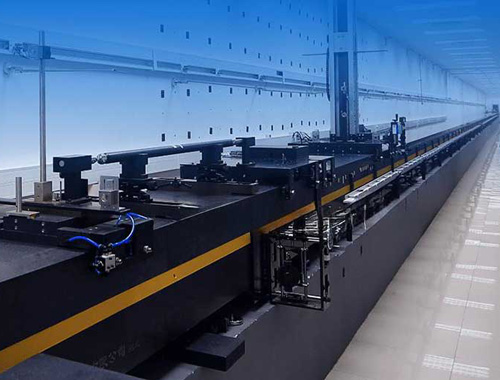
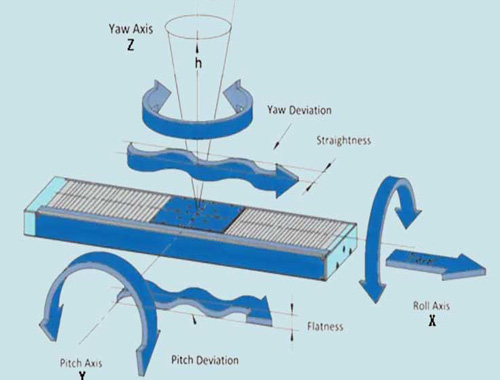
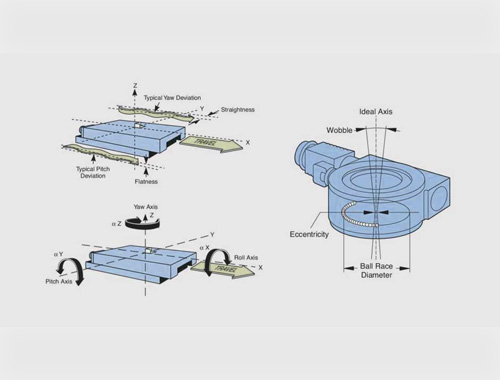
In the world of automated equipment, precision manufacturing, and inspection systems, "positioning accuracy" is the holy grail for almost every engineer. Yet, in real-world applications, we often encounter a frustrating paradox: the specifications of a single linear module look absolutely phenomenal on paper, but once the entire machine is assembled, the overall accuracy falls completely short of expectations.
This brings us to a fundamental question: When it comes to equipment performance, what is really calling the shots—the individual components, or the system as a whole?
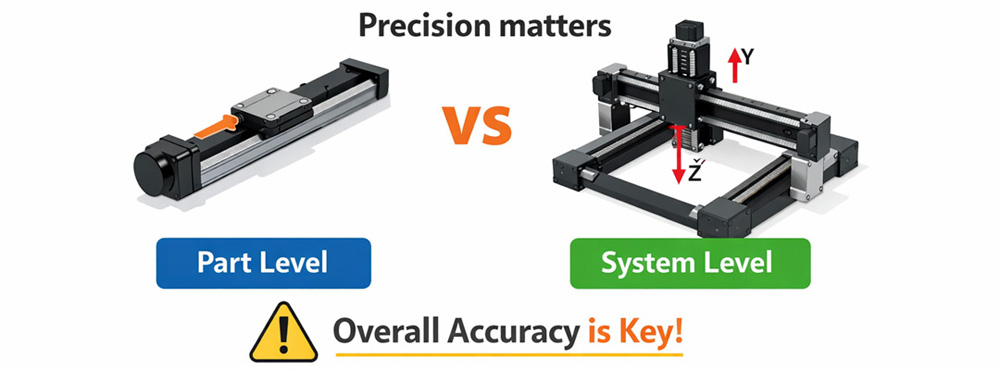
Beyond Simple "Precision": What Exactly is Granite-Based Motion Control System Positioning Accuracy?
To answer this, we first need to define what "system positioning accuracy" actually means. In simple terms, it is the deviation between where the equipment actually stops after moving and its target position. It’s not just about "getting there"; it’s about doing so stably, controllably, and consistently over the long haul under real working conditions.
In a complete piece of equipment, the positioning system is rarely a solo act. It is an ensemble usually made up of:
• Multiple motion axes (X / Y / Z)
• Supporting structures and mounting bases
• Sensors and feedback devices
• Drive and control systems
Therefore, in a fully integrated machine, positioning is never achieved by a single component alone. It is the result of the complex synergy between motion axes, structural parts, sensors, and control units. Because of this, system positioning accuracy is a true reflection of the machine's comprehensive, overarching capability.
When discussing system accuracy, many people naturally think of a closely related metric: repeatability (or repetitive positioning accuracy). While they sound similar, they measure entirely different things.
Clearing the Confusion: Positioning Accuracy vs. Repeatability
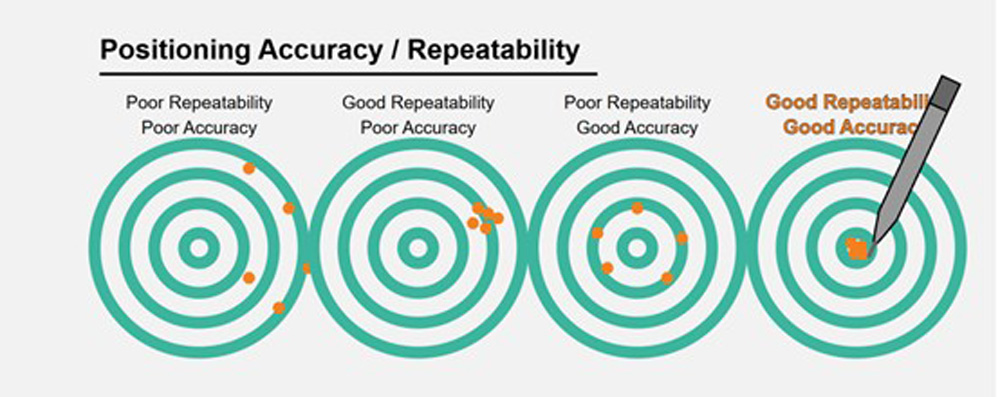
When breaking down precision, these two concepts are notoriously easy to confuse:
Positioning Accuracy
Measures how accurately the system hits the target destination on its first try.
Repeatability
Measures how much deviation occurs when the system returns to the exact same position multiple times.
Let’s use a highly intuitive example—imagine your equipment is an archer shooting arrows:
Positioning accuracy is about whether you hit the bullseye.
Repeatability is about whether all your arrows land in the exact same tight cluster (even if that cluster is far from the bullseye).
A system might have excellent repeatability—"stopping at the exact same spot every time"—but that spot might not be your intended target. Therefore, in the real-world deployment of high-end equipment, these two metrics must always be evaluated together.
Why Do Perfect Modules Make an Imperfect System?
Once we grasp these core concepts, the next logical question arises: If a single module is already highly accurate, why does the system-level accuracy degrade?
The answer lies in error accumulation. System accuracy is not dictated by your "best" component; it is the sum of all stacked errors.
When multiple modules are integrated into a single platform, the system inevitably introduces:
• Micro-deviations from multi-axis assembly
• Deformations caused by insufficient structural rigidity
• Synchronization errors during multi-axis interpolation
• Vibrations generated by high-speed motion
• Thermal expansion triggered by temperature fluctuations
Individually, these factors might seem negligible. But at the system level, they silently accumulate, ultimately manifesting as a noticeable loss of accuracy at the end effector.
This "stack-up" effect is particularly severe in multi-axis and gantry structures. As a system evolves from a single axis to an XYZ platform, and eventually to a gantry system, the overlapping of errors is drastically amplified.
Take a gantry platform, for instance. It typically consists of multiple motion axes and massive supporting structures. If even a microscopic deviation exists in one axis, that error will ripple through the crossbeam, guideways, and connecting joints, infecting the entire system.
System-level issues become glaringly obvious under these specific conditions:
• Long travel strokes
• High operating speeds
• Strict requirements for multi-axis synchronization
This is exactly why, in gantry and multi-axis platforms, the overall structural rigidity and multi-axis coordination capabilities are far more critical than the isolated accuracy of a single axis.
The Invisible Culprit: Abbe Error
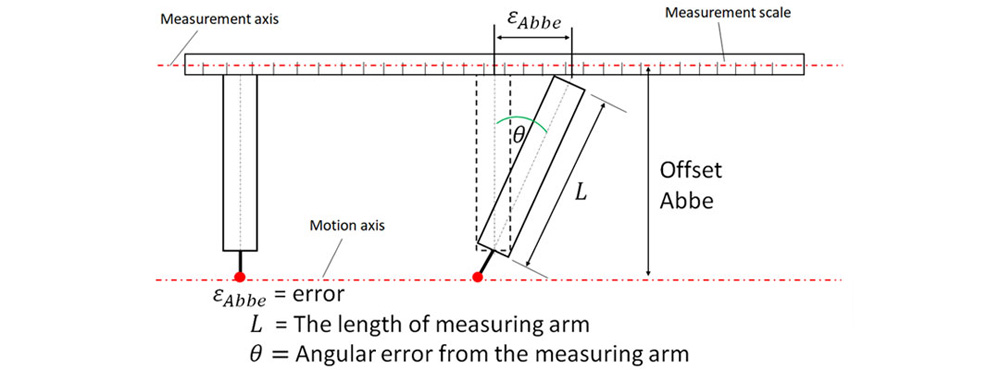
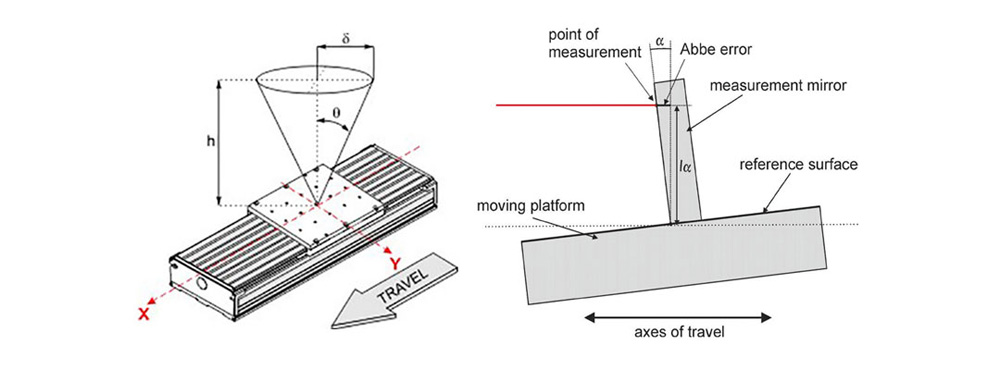
Beyond assembly and structural factors, precision positioning systems harbor another insidious source of inaccuracy that is easily overlooked: the Abbe error.
Think of it this way: When there is a physical offset (distance) between the measurement axis (like an encoder) and the actual motion axis, any minuscule angular tilt during movement is mathematically amplified into a linear displacement error. Abbe error has two distinct characteristics:
• The greater the offset distance, the more severe the amplification.
• The longer the travel stroke, the harder it is to ignore.
Because of this geometric reality, the structural layout and the placement of measurement devices directly dictate the absolute ceiling of a high-precision machine's accuracy.
True System Accuracy is Engineered, Not Just "Assembled"
By now, a clear conclusion emerges: Reliable system positioning accuracy cannot be achieved merely by cobbling together a bunch of high-end parts. It stems from:
• Holistic structural design conceived from a whole-system perspective
• Uncompromising overall rigidity and dynamic stability
• Flawless synchronization and coordination between multiple axes
• Proactive prediction and control of potential errors
It’s not about snapping together "high-precision modules" like building blocks; it’s about unified design and optimization at the system level. In actual engineering projects, the industry is increasingly focusing on whether the entire platform can deliver stable, replicable system accuracy under real-world conditions.
This philosophy is the driving force behind the development of system-level XYZ motion platforms and gantry systems engineered by ND GROUP.
Whether it is the XYZ series motion platforms or the dual/multi-drive gantry platform series, none are simple combinations of individual modules. Instead, ND GROUP designs them around the core demand of system accuracy, ensuring unified excellence in structure, rigidity, multi-axis coordination, and overall stability.
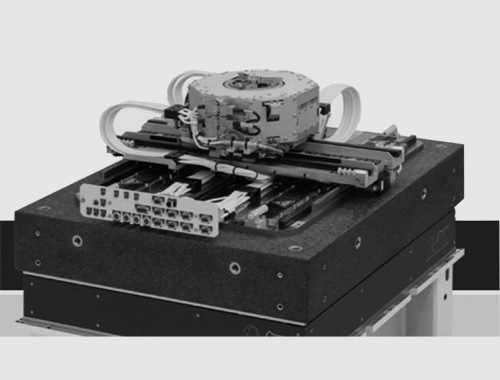
1. XYZ AOI Inspection Platform
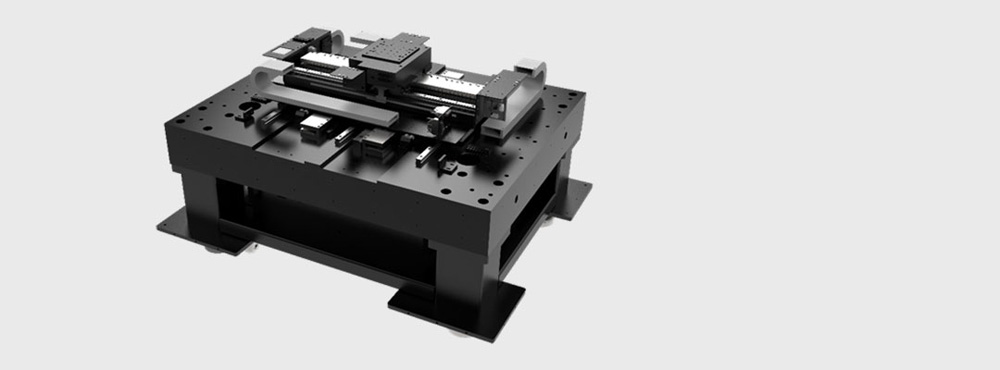
A high-precision, three-axis stacked motion stage designed for demanding industrial applications such as laser processing, optical manufacturing, and automated optical inspection (AOI).
• Features an XYZ stacked architecture driven by ironless linear motors directly.
• Zero cogging effect, ensuring buttery-smooth operation at low speeds (minimal velocity ripple).
• Equipped with non-contact high-precision linear encoders for smooth motion and stable force distribution.
• Delivers exceptional dynamic performance, positioning accuracy, and repeatability.
• The Z-axis utilizes a direct-drive lift structure with a built-in pneumatic cylinder to counterbalance payload weight.
2. XYR AOI Inspection Platform
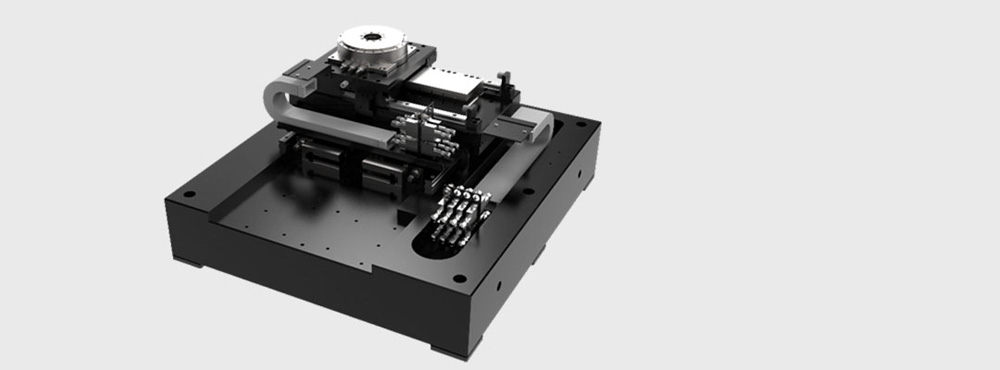
Widely deployed in automotive electronics, display inspection (LED/LCD screens), pharmaceuticals, food, precision parts machining, and dimensional metrology. It ensures the product reaches the exact position for measurement, counting, defect detection, and smart judgment.
• High-precision, ultra-stable direct-drive structural design.
• Utilizes non-contact high-precision linear encoders.
• The XY axes ride on ultra-precision linear guideways.
• Direct Drive (DD) motor axial runout is less than 2μm.
• Post-assembly, the overall platform planarity (surface runout) is less than 10μm.
• Full-stroke repeatability is less than ±1μm.
• Positioning accuracy is less than ±2μm.
3. Air-Bearing Platform for IC Substrate LDI Exposure
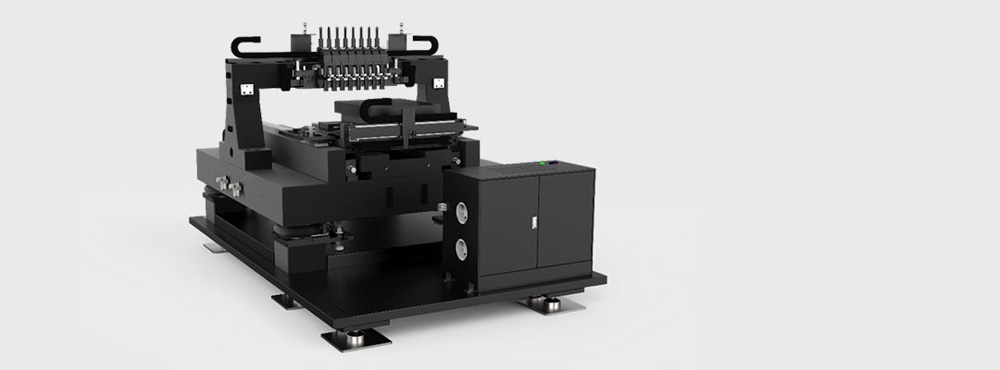
Tailored for industries requiring the highest tiers of precision and throughput, including semiconductor production lines, microelectronics, LCD manufacturing, and PCB/IC substrate Laser Direct Imaging (LDI).
• A multi-axis air-bearing platform utilizing an air-bearing XY stacked structure.
• The XY axes feature fully-enclosed air-bearing guideways for unmatched stability.
• Directly driven by ironless linear motors, completely eliminating the cogging effect.
• Ensures flawlessly smooth operation at low speeds with negligible velocity ripple.
• Equipped with non-contact high-precision linear encoders for top-tier dynamic performance.
• Utilizes ultra-high-resolution optical scales for precision position feedback.
• Full-stroke repeatability is less than 0.5μm, and positioning accuracy is less than 1μm.
Ultimately, precision is never just a number on a spec sheet. It is the culmination of brilliant structural engineering, meticulous assembly, advanced control algorithms, and seamless mechanical synergy.
When we shift our perspective from a single component to the entire system, those "unreasonable problems" that plague engineers suddenly have clear, logical answers.
Interested in our motion control systems? Get in touch with us.
ND GROUP boasts a dedicated custom engineering team bringing together multidisciplinary experts in mechanical design, electrical control, software programming, advanced manufacturing processes, and X-ray technology. Whatever your unique challenges may be, we are fully equipped to deliver the optimal, tailor-made solution for your specific needs.