Knowledge
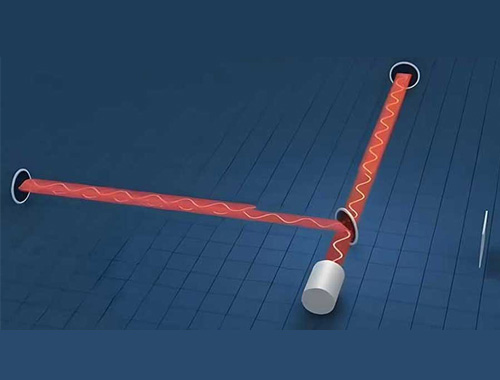
The Fizeau laser interferometer system is not just an ordinary tool; it is a high-precision, common-path interferometer designed for cutting-edge surface metrology. Equipped with advanced ring-source artifact suppression technology, it operates on a fascinating physical principle: interference of equal thickness.
Imagine parallel beams of light striking the upper and lower surfaces of a thin film—one with a uniform refractive index and a uniformly varying thickness. As the light reflects, it creates beautiful interference patterns. Naturally, areas of the film that share the exact same thickness will generate the exact same interference fringe.
In the realm of optics, the Fizeau interferometer is a highly specialized precision instrument. It is the go-to choice for inspecting the surface figure of optical components, detecting wavefront aberrations in camera lenses, and verifying the homogeneity of optical materials. Furthermore, this system truly shines when it comes to measuring spherical surface figures and their radius of curvature with extreme accuracy.
Structure
When you walk into an optics lab, the most common setup you will see is the horizontal Fizeau interferometer. Engineers love it for its simplicity, minimalistic accessories, and incredible flexibility across a wide variety of testing scenarios.
However, the vertical Fizeau interferometer (which comes in both upward-illuminating and downward-illuminating configurations) is equally popular and brings its own superpowers to the table. Testing samples vertically makes loading and unloading incredibly efficient. The structure is inherently more stable and offers superior vibration isolation, making it the perfect workhorse right on the bustling floor of an optical manufacturing plant.
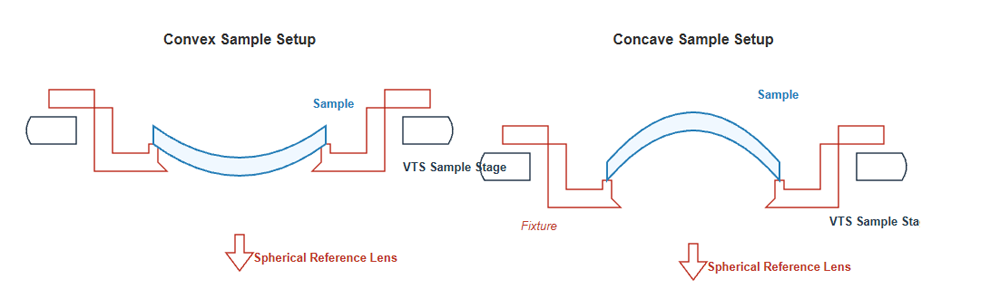
But the real magic of the vertical setup lies in gravity. When a sample rests on the fixture, its own weight naturally seats it in the perfect position, ensuring exceptional "reset" accuracy (positional repeatability) for the spherical interference cavity. Thanks to this reliable repeatability, a vertically configured interferometer can efficiently test the radius of curvature. It does this by comparing the "POWER" (optical power) difference between a test sample and a reference standard, much like the classic method of identifying Newton's fringes on a test plate.

As described by the formula associated with this method, the process is elegantly simple: First, you test a standard reference plate, finely adjusting the setup until you achieve a "zero" fringe. Next, without moving the fixture or the surrounding mechanics, you swap out the reference plate for your actual sample and measure its surface figure directly. By calculating the POWER difference between these two measurements, the system easily determines the sample's "radius of curvature error" relative to the standard master.
Non-standard Customization
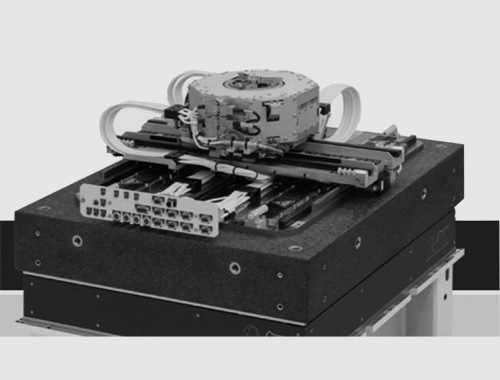
When off-the-shelf equipment isn't enough, ND GROUP steps in. We manufacture and assemble customized vertical adjustment platforms tailored specifically for Fizeau interferometers. These platforms are available in both downward-looking (upward-illuminating) and upward-looking (downward-illuminating) structures. Let's look at the standout features of these heavily engineered systems:
Natural granite motion structure: Ensures ultimate thermal and physical stability (Structure is fully customizable).
Passive vibration isolation system: Keeps the testing environment pristine by absorbing environmental tremors.
High-performance lifting platform: This is where precision meets power. It can cruise at a maximum speed of no less than 20 mm/s, yet crawl at a minimum speed of no more than 1 μm/s. With a staggering resolution of 0.05 μm, it executes flawless 1 μm steps. Furthermore, it boasts a payload capacity of ≥120 kg and features a robust self-locking mechanism to safely elevate and hold heavy loads (Specifications are customizable).
Z-axis travel: A generous 1200 mm stroke (Travel distance is customizable).
Intuitive axis control: The system comes with an independent, handheld touchscreen pendant. Think of it as the brain in the palm of your hand. It integrates every function you need: emergency stop, axis load/unload enabling, absolute positioning, relative motion, and manual jogging. You can easily tweak the speeds for different operation modes right on the screen. Everything is seamlessly integrated into this one smart controller.
Expandability: The system can easily integrate with additional displacement stages for even more complex metrology setups.
ND GROUP boasts a dedicated custom engineering team bringing together multidisciplinary experts in mechanical design, electrical control, software programming, advanced manufacturing processes, and X-ray technology. Whatever your unique challenges may be, we are fully equipped to deliver the optimal, tailor-made solution for your specific needs.